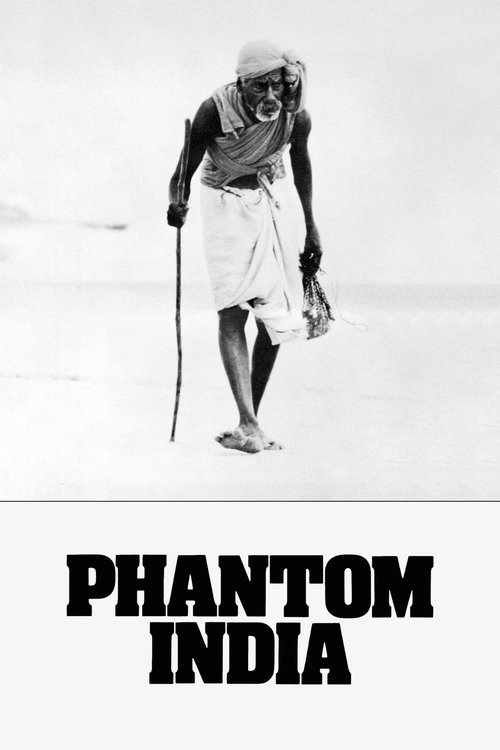
Louis Malle called his gorgeous and groundbreaking Phantom India the most personal film of his career. And this extraordinary journey to India, originally shown as a miniseries on European television, is infused with his sense of discovery, as well as occasional outrage, intrigue, and joy.

How can you capture in the lens of a film camera the essence of a country so diverse, so variegated, and so paradoxical as India?
Southern India pretends to know nothing about the North. Its language is different, its very nature too. In Madras Louis Malle discovers a striking example of that world of opposi…
Louis Malle finds a devotion to a spiritual life that transcends the poverty of the material one and discovers that in a country as crowded as India, religion is the one way for t…
Drifting at random through the numberless villages of the South, Louis Malle finds himself in a timeless, fantastic, and to a western eye, almost surrealist world. Kerala is like …
Although officially abolished, the caste system has not ceased to exert a strong influence on Indian social life. It is not a problem of colour, race nor even of class. It is far …
Turning aside from the traditional India of the Hindus, Louis Malle pans his camera on to the India of forgotten tribes and tiny sects. He discovers two versions of Utopia: one, t…
Bombay. It's the last lap of Louis Malle 's journey through India and already it smacks of the West. Bombay is a city on the move, in the middle of an economic boom. Parsee indust…
No streaming providers available.