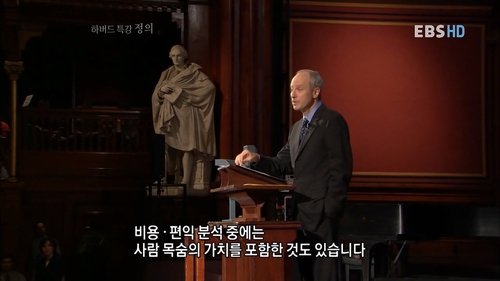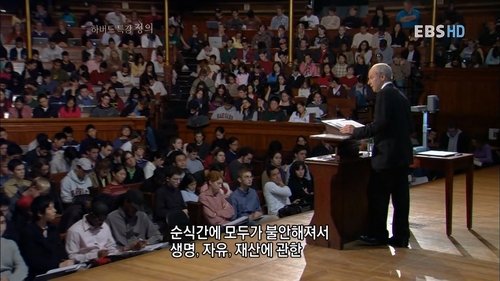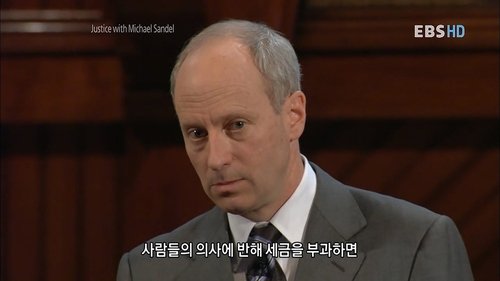
Justice is the first Harvard course to be made freely available online and on public television. In this 12-part series, college professor Michael Sandel challenges us with hard moral dilemmas and invites us to ponder the right thing to do—in politics and in our everyday lives.
If you had to choose between killing one person to save the lives of five others and doing nothing, even though you knew that five people would die right before your eyes if you d…
Sandel presents some contemporary cases in which cost-benefit analysis was used to put a dollar value on human life. The cases give rise to several objections to the utilitarian l…
Sandel introduces the libertarian notion that redistributive taxation—taxing the rich to give to the poor—is akin to forced labor. If you live in a society that has a system of pr…
The philosopher John Locke believes that individuals have certain rights—to life, liberty, and property—which were given to us as human beings in the “the state of nature,” a time…
During the Civil War, men drafted into war had the option of hiring substitutes to fight in their place. Many students say they find that policy unjust, arguing that it is unfair …
Professor Sandel introduces Immanuel Kant, a challenging but influential philosopher. Kant rejects the notion that morality is about calculating consequences. When we act out of …
Immanuel Kant believed that telling a lie, even a white lie, is a violation of one’s own dignity. Sandel introduces the modern philosopher, John Rawls, who argues that a fair set …
Rawls argues that even meritocracy—a distributive system that rewards effort—doesn’t go far enough in leveling the playing field because those who are naturally gifted will always…
Students discuss the pros and cons of affirmative action. Should we try to correct for inequality in educational backgrounds by taking race into consideration? Should we compensat…
Aristotle believes the purpose of politics is to promote and cultivate the virtue of its citizens. The telos or goal of the state and political community is the “good life”. And t…
Communitarians argue that, in addition to voluntary and universal duties, we also have obligations of membership, solidarity, and loyalty. These obligations are not necessarily ba…
If principles of justice depend on the moral or intrinsic worth of the ends that rights serve, how should we deal with the fact that people hold different ideas and conceptions of…
No streaming providers available.