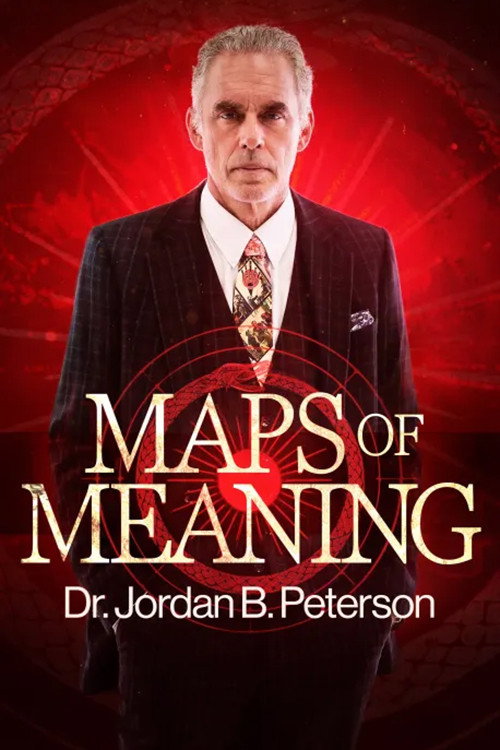
In Maps of Meaning, a twelve-hour course, Dr. Jordan B. Peterson explores the foundations of human consciousness, perception, and the pursuit of meaning. Drawing from psychology, mythology, and neuroscience, he examines how we navigate the tension between order and chaos—not as passive observers, but as active participants guided by goals and values. Central to this exploration is the archetypal hero’s journey, which shows how voluntarily confronting suffering and taking responsibility can transform both the individual and society. Grounded in decades of research and personal experience, Dr. Peterson reveals how religious symbols, archetypal narratives, and social hierarchies shape both the individual mind and collective culture. Through powerful insights, the course demonstrates that proper orientation toward the highest good enables us to transform chaos into meaningful order.

In our introductory lecture, we explore two fundamental ways of perceiving the world: the materialist view of what the world is made of versus the action-oriented view of how to a…
In lecture two, we study how to find one's way forward through self-negotiation, examining how we perceive the world not as objects but as pathways, tools, obstacles, friends, foe…
In lecture three, we analyze the ancient concepts of yin and yang as fundamental representations of chaos and order, examining how these principles manifest in consciousness, myth…
In lecture four, we continue to investigate how reality is conceptualized through phenomenological, cybernetic, and narrative perspectives, framing experience as a balance between…
In lecture five, Dr. Peterson introduces us to the concept of nested dependencies and hierarchical structures in reality, using examples from life to illustrate how disruptions at…
In lecture six, we learn how human consciousness and society are organized through the integration of religious symbolism, social hierarchies, and neuropsychological structures. W…
In lecture seven, we study the meta narrative of transformation that underlies all stories, examining how stable frames of reference are disrupted by unexpected events, leading to…
In lecture eight, Dr. Peterson continues the analysis of narrative structures that underlie human experience, examining how ancient stories from Mesopotamian, Egyptian, and Biblic…
In lecture nine, we turn to the archetypal patterns of gods and goddesses emerging from chaos, with the feminine principle bifurcating into destructive and benevolent aspects of n…
In lecture ten, Dr. Peterson unravels the hero's narrative as the pathway to "life eternal," examining how the hero confronts chaos to establish order through proper intent and sa…
In lecture eleven, Dr. Peterson compares the complex narratives of Moses and Christ, examining how these stories interconnect with themes of transformation, redemption, and the na…
In our twelfth and final lecture, we explore the theological and psychological significance of Mary's suffering alongside Christ, examining how her willingness to bear a child des…
No streaming providers available.